
Kelian Lalloué
In this article:
A law firm blog draws steady traffic when it answers the questions prospective clients type into Google, in plain English, on a site built to rank. That takes four pillars working together: client-focused content, clean structure, internal links to your practice area pages, and credibility from other websites. Publishing at random rarely works.
This is the method we used to take one law firm's blog from about 8,000 to 20,000 monthly visits in 12 months (see the case study). Below: why legal blogs stall, the four pillars, US topic ideas, and the ethics rules.
Why most law firm blogs get no traffic
Writing for other lawyers instead of clients
Many lawyers blog the way they write a brief: dense, technical, and full of Latin. The people who hire you search for something else, such as "what happens at a first DUI court date" or "can my ex move out of state with our kids." If a post never answers that question in their words, Google has no reason to show it.
Pulling one lever out of four
The second mistake is treating the blog as a writing project only, with no plan for keywords, page structure, internal links, or backlinks. Content is one pillar out of four. Without the other three, even an excellent post stays buried on page five of the results.
The 4 pillars of a law firm blog that ranks
We call them the 4 Cs: content, code, connections, and credibility. Our law firm SEO guide covers them in depth, and our guide to law firm content marketing covers editorial planning.
1. Content: answer your clients' questions
Write for the person with the problem, not for opposing counsel. Start from real questions: Google's "People also ask" box, autocomplete suggestions, your intake calls, and first consultations. An AI assistant such as ChatGPT can suggest variations, but the list should come from search data, as our guide to keyword research for lawyers explains.
Google's guidance on helpful, people-first content values first-hand expertise and bylines. For a law firm, that means a named attorney as author and examples from practice that no reader could trace back to a client.
2. Code: give every post a clear structure
You do not need to code, but you need clean H1, H2, and H3 headings: one H1 for the title, H2s for the main questions, H3s for details. Google's SEO Starter Guide says heading order does not matter for Search, but a clear outline helps readers find their answer fast.
A simple template works for most posts: the answer in the first two sentences, then the explanation, the exceptions, the next step, and a short FAQ. Check the heading outline with a free SEO browser extension before you publish.
3. Connections: link every post to the next step
Each post should link to related posts and, above all, to the matching practice area page and your contact page. A post on the deadline to file a car accident claim in Florida should lead to your personal injury page. Group posts into topic clusters, and use internal links with descriptive anchor text so readers and Google know what comes next.
4. Credibility: earn links from trusted sites
The more trusted websites cite you, the more weight Google gives your pages. Aim for relevant backlinks: state and local bar associations, legal directories, alumni publications, local news, and trade journals. Skip paid links: Google's spam policies treat buying links for ranking purposes as link spam.
Legal blog topics: law blog ideas for US firms
The best legal blog topics are questions people actually type, often with a state name or a deadline in them. Each has a small search volume, but these long-tail keywords come from people who need a lawyer now.
Deadline questions: "how long do I have to file?"
- Personal injury: "How long do I have to file a car accident claim in Texas?"
- Medical malpractice: "Is there a deadline to sue a hospital in Florida?"
- Employment: "How long do I have to file an EEOC charge?"
- Probate: "How long does probate take in California?"
Cost and process questions
- Criminal defense: "What happens at an arraignment?"
- Small claims: "Do I need a lawyer for small claims court in New York?"
- Family law: "How does child custody mediation work in Colorado?"
- Workers' compensation: "How are workers' comp benefits calculated in Illinois?"
Situation questions: "can I" and "what if"
- Landlord and tenant: "Can my landlord keep my deposit for normal wear and tear?"
- Employment: "Can I be fired for filing a workers' comp claim?"
- Personal injury: "What if the driver who hit me has no insurance?"
- Criminal defense: "Can police search my car without a warrant?"
Give each question its own post with one clear answer. For state topics, cite the statute, link to the official source, and show when the post was last reviewed.
Legal blogging ethics: ABA Rule 7.1 and Formal Opinion 480
Rule 7.1: nothing false or misleading
ABA Model Rule 7.1 bars false or misleading communications about a lawyer's services, advertising included. Even a truthful report of past results can mislead if it creates an unjustified expectation of the same outcome. So no "we always win," no unverifiable "best DUI lawyer in Phoenix," and context around any verdict you mention.
Formal Opinion 480: confidentiality covers public records too
In Formal Opinion 480 (March 6, 2018), the ABA addressed lawyer blogging directly. Lawyers who blog may not reveal information relating to a representation, including information in a public record such as a court order, without the client's informed consent or another exception. Calling a story a "hypothetical" does not help if readers could still identify the client. The opinion also recommends, where practicable, a disclaimer that reading the content does not create an attorney-client relationship.
Check your state's version
Each state adopts its own rules, and those control. In California, Formal Opinion 2016-196 says a blog that is an integrated part of a firm's website is subject to the attorney advertising rules, like the website itself. See our guide to lawyer advertising rules.
Case study: how we took a law firm blog from 8,000 to 20,000 monthly visits
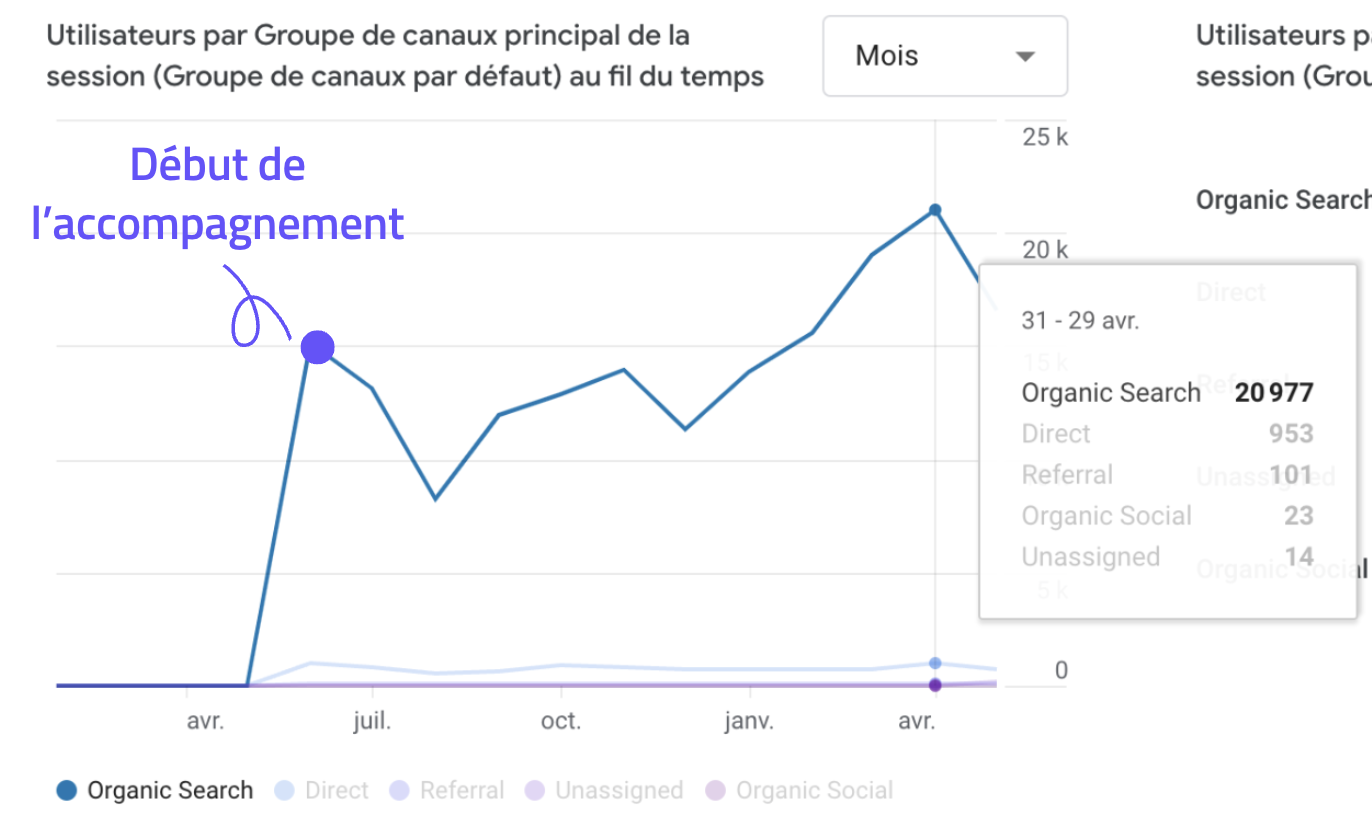
Where the firm started
Our client was a three-partner business law firm in Paris. Its blog already drew about 8,000 visits a month without specialized help, but traffic was declining and the articles were not organized around the searches that bring in clients.
What we changed, and the result
We applied the four pillars: a content plan built on high-value keywords, a blog architecture Google could read, internal links to the practice pages, and a smoother path to the contact form. Twelve months later, the blog drew 20,000 visits a month and qualified leads were up 120%. Details are in our law firm SEO case study.
What results can you expect from a law firm blog?
Traffic depends on your practice area and market
In our work with law firms, blogs built on these four pillars draw anywhere from 1,000 to 20,000 visits a month, depending on the practice area, the market, and the authority the site starts with. So 10,000 visits a month is not a promise: it is a milestone our client blogs have passed, as our 20,000-visit case study shows. Our method for 10,000 monthly SEO visits details the site structure behind it.
How often to publish, and when to update
Consistency beats volume. In our experience, two well-researched posts a month do more than ten thin ones, and Google says it has no preferred word count. Expect results in months, not weeks. Update a post when a statute or deadline changes, as Google's SEO Starter Guide advises for published content.
Want us to build it with you?
These four pillars are the core of our work for law firms at Hendy. If you would rather spend your time on clients than on content calendars, we can take it from here.
- Solo practitioners: a steady flow of new matters without chasing referrals.
- Small law firms: a way to stand out in a crowded local market.
- Large law firms: a measurable content program that fits your review process.
Book a call and we will send you a personalized growth plan for your firm's blog.
Frequently asked questions
-
Not every firm needs one, but a blog is the most practical way to rank for the many specific questions prospective clients search, which practice area pages alone cannot cover. Each post answers one question and links to the matching practice area page. Firms that rely only on referrals can skip it, but they leave that search demand to competitors.


"Premium Divorce Austin"↗


4.8 based on 30+ clients




Only 5
law firms per year
Imagine 50% of your revenue coming from Google.
Position your law firm smartly in search results with our SEO and Google Ads expertise. See how we deliver stable, predictable results over time, all in an automated way.